
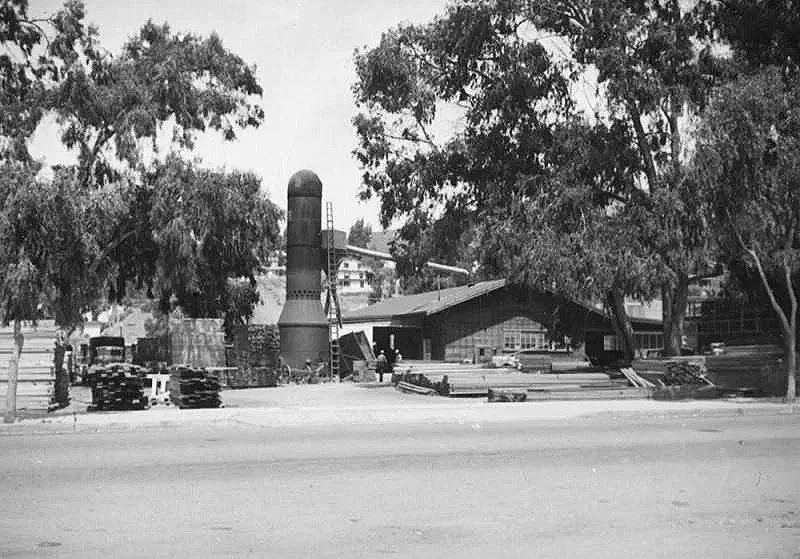
By Hunter Fuentes and Jon Stordahl
The Lumberyard
The Laguna Beach Lumberyard Building is celebrating its centennial this year. It is one of the most beautiful and unusual buildings in town. The noted American architect Louis Sullivan is considered one of the fathers of modern architecture. He famously asserted that “Form follows function,” that a building’s design should conform to its purpose. Today when you conjure an image of a lumberyard what comes to mind is a space more akin to a Home Depot than our downtown landmark. This whimsical structure is the antithesis to Sullivan’s assertion. Here, function was sacrificed to form, to beauty.
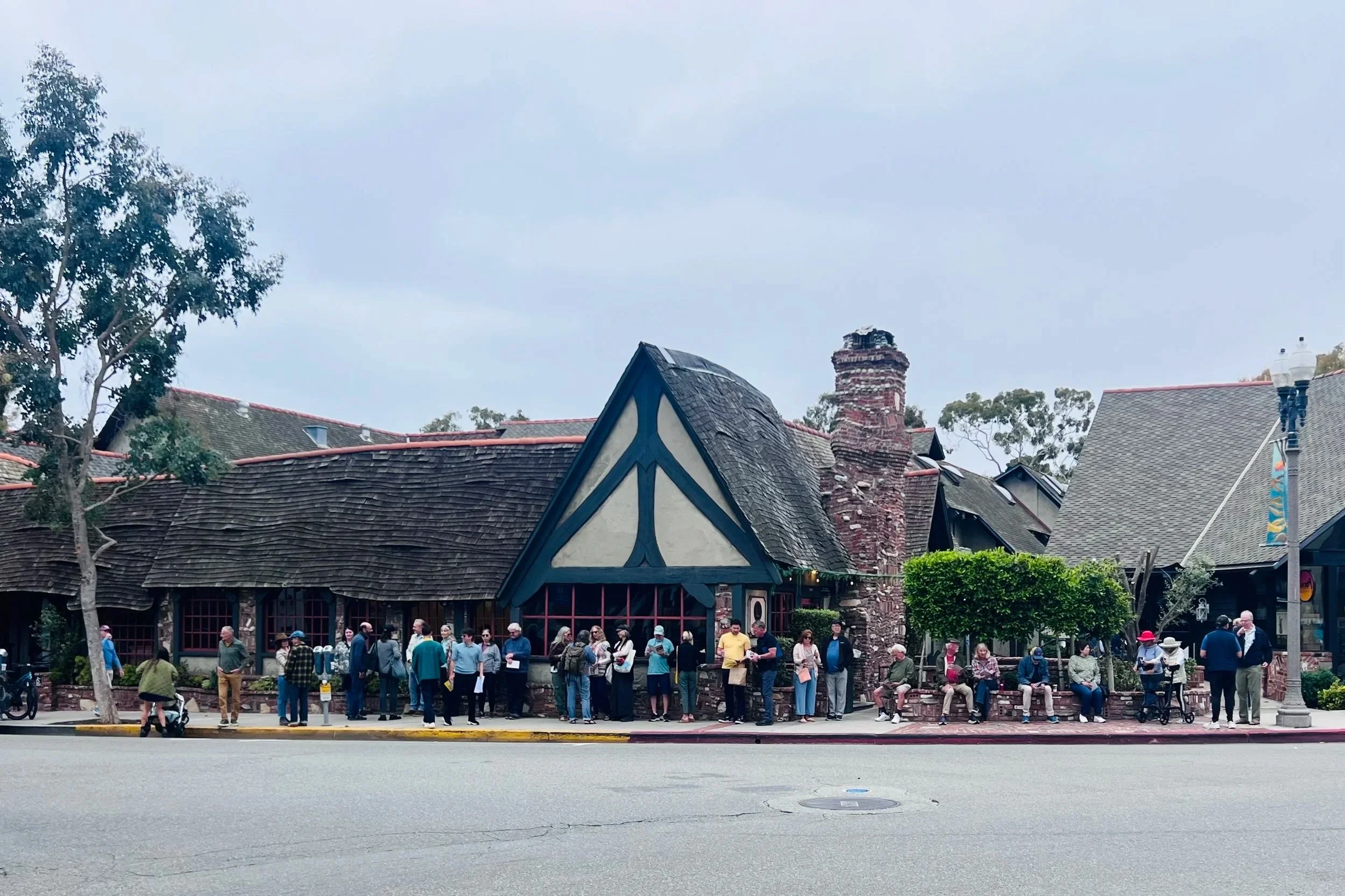
The Lumberyard Restaurant as it stands today. Photo by TJ Fink from the 2026 Architectural Trolley Tour..
The Laguna Beach Lumber Company was founded by Joe Jahraus and incorporated in November 1914. Business operations were interrupted when the United States joined the First World War in the spring of 1917. Joe enlisted in the US Army, serving in Company C, 33rd Engineers. He spent over a year in France. Like many of his fellow Doughboys, his time in France left a powerful impression on Joe. He returned to Laguna and to his lumber business in 1919. Laguna Beach Lumber was rapidly expanding in the post-war years and had outgrown its existing facilities. In 1923 Joe met a charismatic architect who had just settled in town.
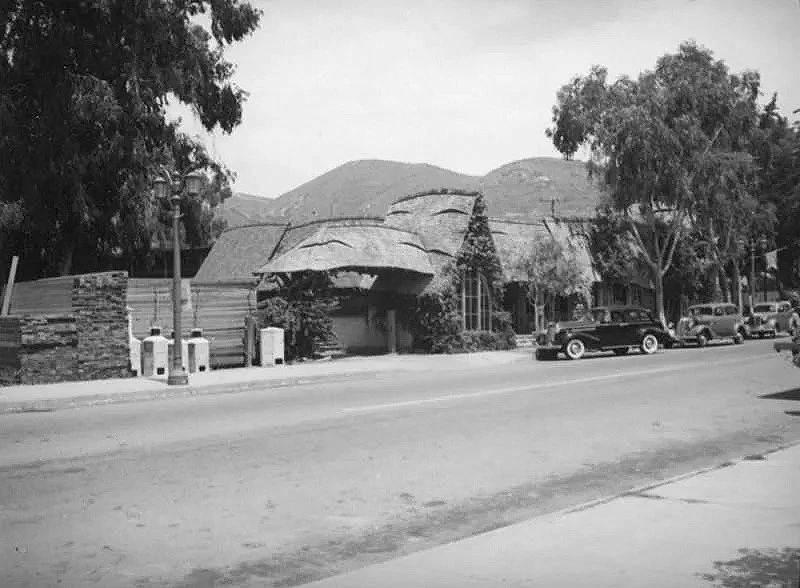
Laguna Beach Lumber, 1938. Photo by Herman Schultheis.
Courtesy of the Los Angeles Public Library Photo Collection.
Jean Louis Egasse was born in Paris in 1886. He had a difficult childhood. He lost both parents by the time he was 15. Over the next dozen years, he lived for extended periods in Spain and Britain, acquiring new languages, a growing knowledge of design, and a wife. By 1913 the couple was living in Southern California. The first architectural projects ascribed to Egasse were built in the Los Angeles area in the early-1920’s. In 1923 he was commissioned by Albert and Constance Braasch to design a residence in Eagle Rock. This project was followed by the Hanson Residence in Silverlake the following year. In 1923 Egasse arrived in Laguna and was working on his first local commission, the Ark House at Woods Cove. That project led to the first meeting of Egasse and Jahraus. In a 1968 oral interview with Helen Keeley, Joe recalled “… a man with a French accent came into the lumberyard.” After thumbing through Egasse’s sketchbook, Joe asked him to design a building that would remind the young veteran of his time in France.. Construction began in late 1925 and was completed in the spring of 1926.
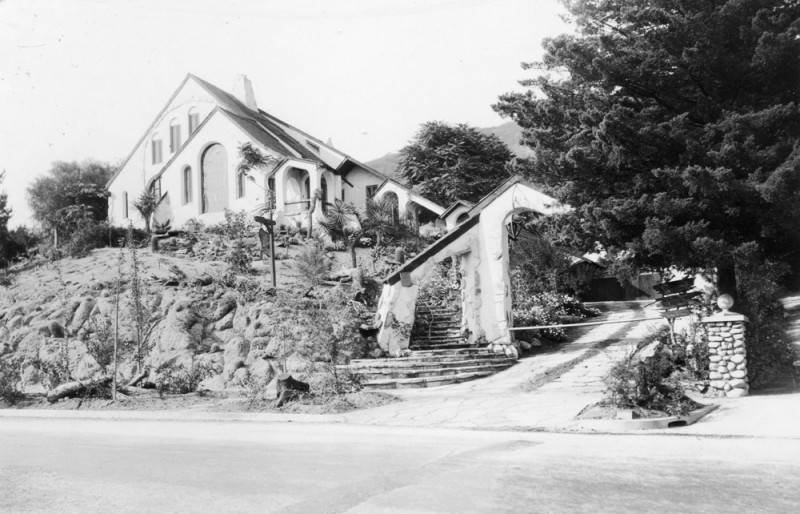
Egasse-Braasch House, 2327 Hill Drive in Los Angeles, CA.
Photo courtesy of the Los Angeles Public Library Photo Collection.
The building is a work of art. While there are Norman and French influences, its whimsical characteristics are more Storybook. Steve Carney, of the LA Times, described the Storybook style in a 2018 article as “… crooked timbers, cockeyed chimneys and details that range from medieval to mirthful …” The Lumberyard reflects many of those elements and more. Built of brick and wood, the building is 72-feet wide and 50-feet deep. The interior beams were fashioned from rough-hewn timber and stained to appear older. The shake roof undulates like waves on the ocean. The asymmetrical windows only accentuate the sense of fantasy. Joe Jahraus himself supervised construction.

Photo courtesy of the Laguna Beach Historical Society.
The Egasse style was not tailored to the mass market. In 1920’s Southern California, variations of Spanish Colonial had come to dominate residential and commercial architecture. The Egasse client needed to be willing to embrace his vision. While the Lumberyard was under construction, Egasse built his own personal residence, the Crescent Bay Castle, on North Coast Highway. The following year, Joe’s father, Elmer, commissioned the architect to design the beautiful South Coast News Building at 305 Forest Avenue. He completed only a few other projects before abruptly leaving the Laguna in the early-1930’s. Egasse settled in Santa Barbara where he dabbled in teaching and design. He changed his name to J.L.E. d’Argastal. The November 15, 1953 Santa Barbara News Press ran a story about a home he designed for Dr. and Mrs. Byron Gifford. The article describes the home, built on a sprawling 25-acre site, as “Norman-Spanish.” It was his last project. He died in that city in 1965. Joe Jahraus ran the Laguna Beach Lumber Company for more than half a century. He died in 1969.
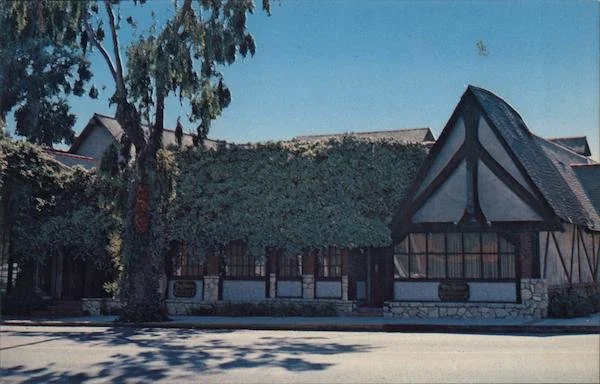
The Ivy, vintage post card collection.
In 1975 the venerable old building found new life as a restaurant. First as the Ivy, then Cedar Creek, and for the past 18 years as the Lumberyard. That transformation has kept the building a center of community life. The artist Constantin Brancusi observed that “Architecture is inhabited sculpture.” I can’t imagine a better description of the Lumberyard.
Laguna Beach Lumber, 1938. Photo by Herman Schultheis.
Courtesy of the Los Angeles Public Library Photo Collection.
